 AIM SECTOR
Delta Force Weapon Stats Explained: Damage, Control, Handling, Stability and More
Written by Marcelo (marcelob465)
What every Delta Force weapon stat really does: Damage, Range, Control, Handling, Stability, Accuracy and Armor Penetration, with worked examples.
Delta Force weapon stats are summary ratings, not single physical measurements. Control governs recoil, Stability governs how steady your sight picture stays, Handling governs how quickly the gun responds, Accuracy mainly governs hipfire spread, and Range sets where damage starts to fall off. Damage on its own never tells you a weapon's time to kill.
That is why two guns with the same Control can feel completely different, and why the biggest green number in Gunsmith is not always the best attachment choice. Each rating bundles several underlying values, and Gunsmith's Details screen shows what actually changed.
This guide explains what every weapon stat does, what it does not do, and how to read the numbers when you build a gun. Worked examples use hypothetical values unless they are labeled as official.
Every Delta Force Weapon Stat at a Glance
| Stat | What it controls | What it does not do | Matters most for |
|---|---|---|---|
| Damage | Base damage per hit, before hit location, distance and ammo | Tell you time to kill by itself | Comparing killing potential |
| Range | How far the first damage tier extends, in meters | Set the maximum distance a bullet travels | Medium- and long-range fights |
| Control | Vertical and horizontal recoil, plus firing stability | Make the sight picture calmer on its own | Automatic fire and recoil-heavy guns |
| Handling | ADS time, sprint-to-fire, movement speeds, reloads | Change recoil or hipfire spread | Aggressive and close-range play |
| Stability | Breathing sway, flinch, movement wobble, lens shake | Replace Control for recoil | Holding angles and magnified optics |
| Accuracy | Hipfire spread | Make ADS shots land closer to the center | Hipfire SMGs and shotguns |
| Fire Rate | Rounds per minute (RPM) | Make a gun kill faster without enough damage | TTK and ammo use |
| Capacity | Rounds before a reload | Come free of Handling and reload penalties | Multi-enemy fights |
| Muzzle Velocity | Bullet speed in meters per second | Change how fast the gun fires | Moving targets at distance |
| Armor Penetration | Damage dealt to armor durability in Operations | Mean the same thing as ammo Penetration Level | Fighting armored enemies |
| Fire Mode | Single, burst or automatic options | Apply to every weapon equally | Recoil and firing rhythm |
Why the Headline Stats Hide So Much
The six bars in Gunsmith (Damage, Range, Control, Handling, Stability and Accuracy) are summaries. Each one groups several underlying parameters, which you can inspect on the weapon's Details screen.
Team Jade's official balance notes show this clearly. In the July 2025 notes, the MP7 received an Operations change that cut its Accuracy rating from 68 to 60, raised its maximum spread from 4.0 to 6.0, and separately adjusted how spread grows during sustained hipfire. One rating moved, but three behaviors changed.
The practical rule: use the headline stat to spot a problem, then use the Details screen to confirm what an attachment really changes.
Delta Force Damage Stat Explained
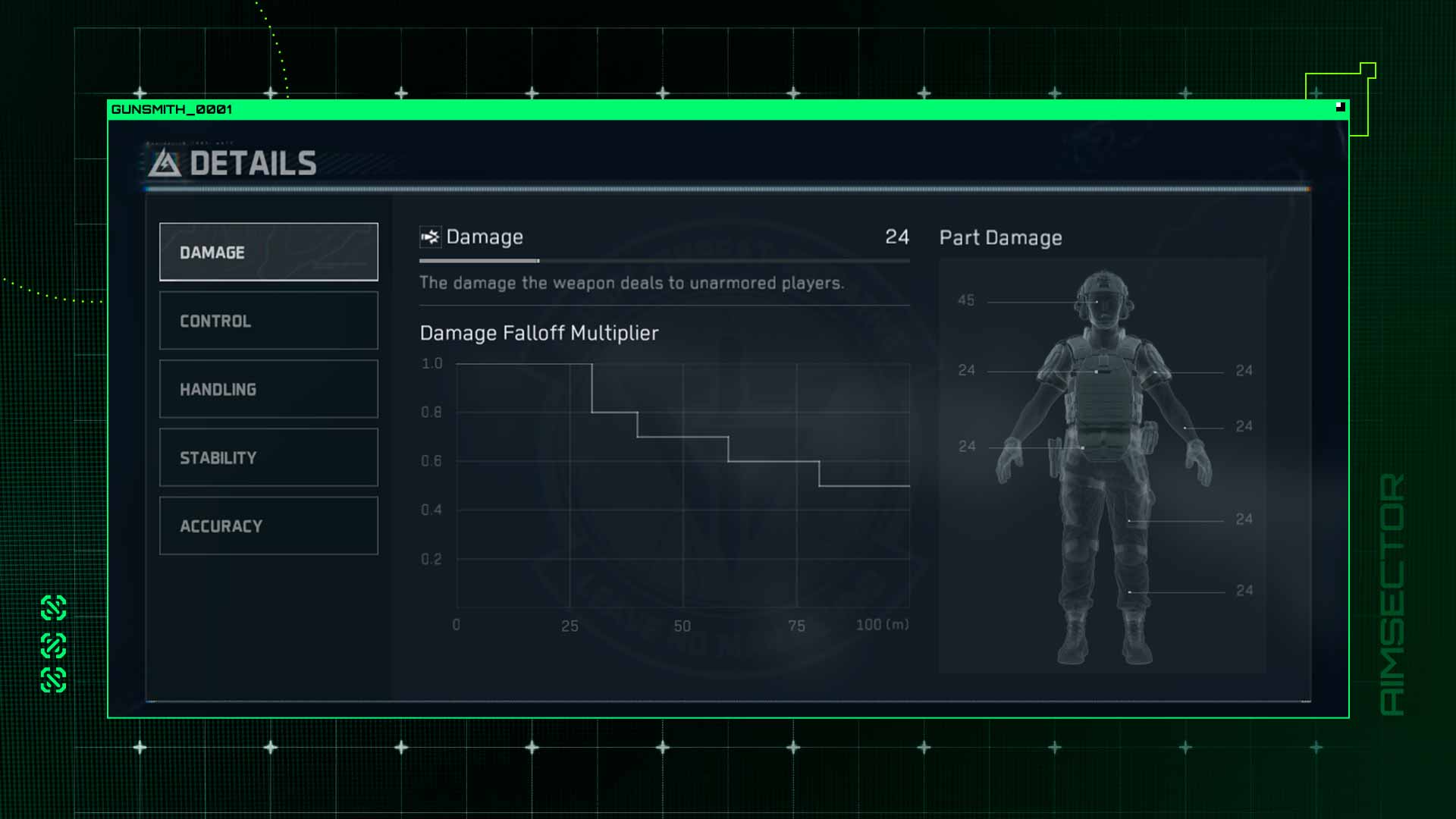
Damage is the base damage of a successful hit, normally measured against the chest. It is not the damage every bullet deals.
Actual damage changes with where you hit, how far away the target is, and, in Operations, the ammunition and armor involved. A simplified conceptual model looks like this:
This is a teaching model, not a published game formula. Operations also tracks armor durability and can deal partial damage on the shot that breaks armor.
Damage changes with hit location
Delta Force uses weapon-specific multipliers for the head, chest, abdomen and limbs, and the values vary by weapon and mode. For a hypothetical gun with 24 chest damage:
| Hit location | Example multiplier | Damage |
|---|---|---|
| Head | 1.8× | 43.2 |
| Chest | 1.0× | 24 |
| Abdomen | 0.9× | 21.6 |
| Limbs | 0.5× | 12 |
These multipliers are illustrative only. Real values differ by weapon, and Team Jade changes them independently of the headline Damage stat. For example, the July 2025 notes raised the SR-25's Operations abdomen multiplier from 0.9 to 1.0 and its limb multiplier from 0.4 to 0.5.
Damage breakpoints decide time to kill
Against a 100 HP unarmored target, 24 damage per chest hit needs five hits. At 25 damage, four hits are enough.
On a hypothetical 750 RPM weapon, the gap between shots is 0.08 seconds (60 ÷ 750). Five hits take four intervals, or 0.32 seconds. Four hits take three intervals, or 0.24 seconds.
Going from 24 to 25 damage removes an entire firing interval. Going from 24 to 24.5 changes nothing, because five hits are still needed. A small Damage change matters a lot when it crosses a shots-to-kill breakpoint, and almost nothing when it does not.
Delta Force Range Stat Explained
Range is the distance, in meters, over which a weapon keeps its first damage tier. Beyond that, damage drops according to the weapon's own falloff profile.
Range is not the maximum distance a bullet can travel, and it does not directly describe bullet speed, drop or recoil. Those are separate mechanics.
Falloff is also not universal. Team Jade publishes weapon-specific falloff distances and multipliers. In October 2025, for instance, the AS Val received separate damage multipliers at 27 m and 54 m. A single Range number cannot describe that whole curve.
Worked example: one falloff step
Suppose a 24-damage weapon has a hypothetical 0.8× multiplier in its second tier. Damage becomes 19.2, so a 100 HP target now needs six chest hits instead of five. On the same 750 RPM weapon, ideal TTK rises from 0.32 seconds to 0.40 seconds.
Range attachments
Longer barrels and some suppressors extend effective range, either by a percentage or by a fixed number of meters. A 20% bonus on a 30 m first tier moves it to 36 m:
Whether that is worth a Handling penalty depends on how often you fight between 30 m and 36 m, and on what the next damage tier does.
Delta Force Control Stat Explained
Control is Delta Force's main recoil stat. If your gun climbs or drifts while you fire, Control is the first place to look.
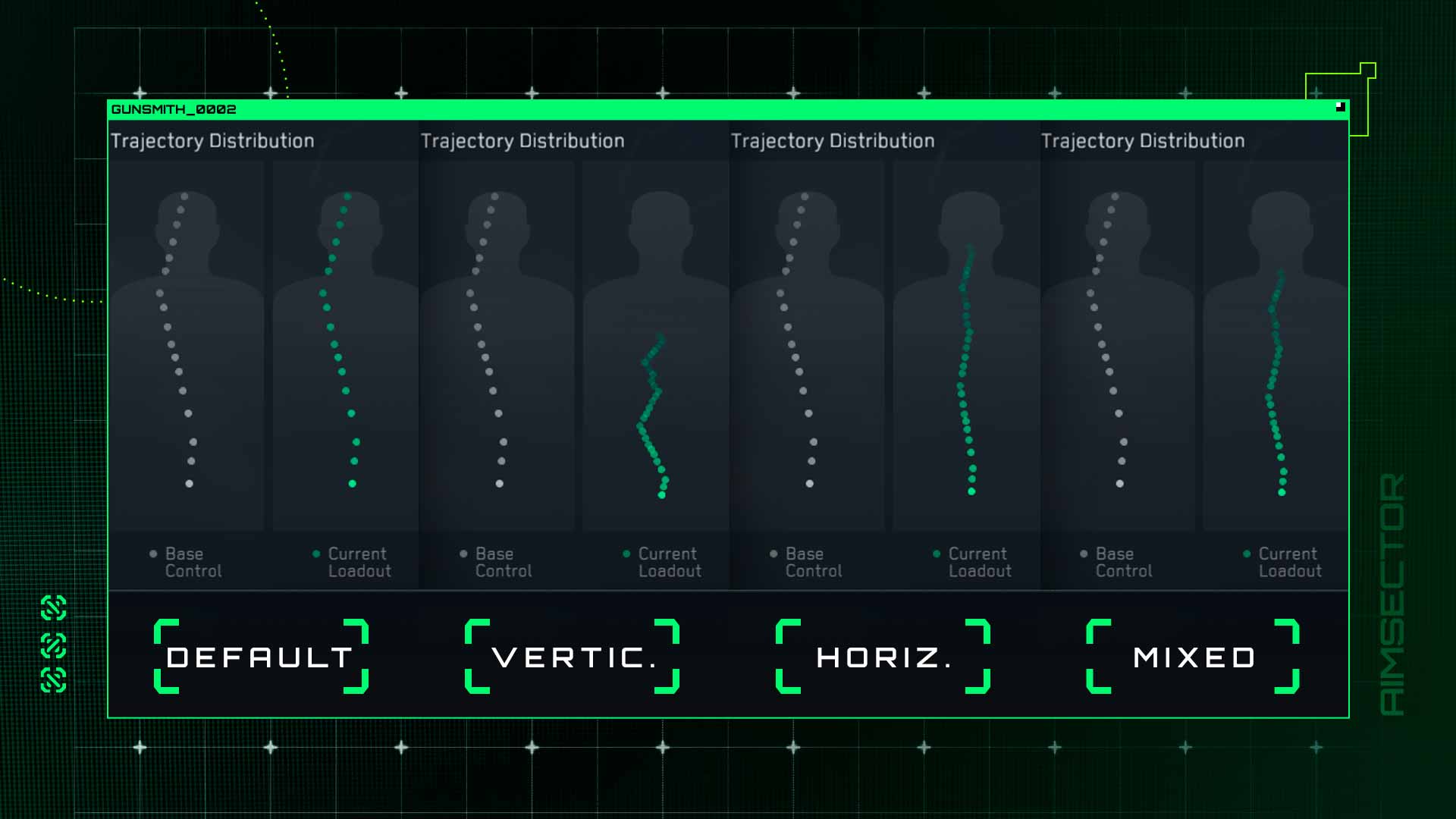
A Control of 77 does not mean 77% less recoil. The number summarizes several underlying values, which the Details screen lists separately:
| Underlying value | What it changes |
|---|---|
| Full-auto vertical recoil multiplier | Upward climb during automatic fire |
| Full-auto horizontal recoil multiplier | Sideways drift during automatic fire |
| Single/burst vertical recoil multiplier | Upward kick on single shots and bursts |
| Single/burst horizontal recoil multiplier | Sideways kick on single shots and bursts |
| Weapon stability while firing | Shot-induced weapon and sight disturbance |
That last row is easy to miss. Its name contains the word "stability," but it sits under Control, not under the Stability stat.
Vertical vs horizontal recoil
Vertical recoil pushes the sight upward. It is fairly predictable, so you can usually counter it by pulling your mouse, stick or thumb downward.
Horizontal recoil moves the sight left and right. It is harder to counter because you have to react to sideways movement while also tracking a target.
That is why a smaller headline Control bonus can beat a larger one. If your rifle mostly climbs, an attachment that cuts vertical recoil helps more than one that cuts horizontal recoil, even if the second shows a bigger number.
Judge recoil by the multipliers, not the Control bonus
Suppose the Details screen shows these values before and after an attachment (hypothetical):
| Recoil value | Before | After |
|---|---|---|
| Vertical multiplier | 0.80× | 0.64× |
| Horizontal multiplier | 0.90× | 0.72× |
Lower multipliers mean less recoil. Each value fell by the same proportion:
That 20% reduction is the real improvement. It makes no difference whether the headline Control bar rose by 5, 10 or 15 points if the recoil direction you struggle with barely moved.
Why two guns with the same Control feel different
The headline number ignores several things that shape recoil:
- The weapon's own recoil pattern. A mostly vertical rifle with 65 Control can be easier to use than one with 77 Control and messy horizontal behavior.
- Rate of fire. A 900 RPM gun fires every 66.7 ms and a 600 RPM gun every 100 ms. The faster gun applies recoil more often and leaves less time to correct between shots.
- Firing mode. Full-auto and single/burst recoil use separate multipliers.
- Firing stability. This can change how much the sight shakes without changing the basic recoil trajectory.
In our controlled testing, we found an example of that last point. An AKM with a muzzle brake showed its firing stability multiplier fall from 1.00× to 0.76× while its directional recoil multipliers stayed the same. We could also report a visibly clearer sight picture. Treat this as a reported result for one weapon, not a universal rule.
Delta Force Stability Stat Explained
Stability controls unwanted aiming disturbance: breathing, movement, getting hit and sight shake while firing. It overlaps with recoil in a few places, but it does not duplicate Control.
The Details screen breaks it into these values:
| Underlying value | What it does |
|---|---|
| Breathing sway range | Moves the sight in a small angle while you breathe |
| Breath-hold duration | How long you can hold your breath to steady the sight |
| Breath-hold recoil reduction | An extra recoil multiplier that applies while you hold your breath |
| Hit-flinch multiplier | How much your aim is knocked when you take damage |
| Movement stability | Sight wobble while moving |
| Lens firing stability | How much the sight image shakes when you fire |
without firing, the sight drifts slightly as your operator breathes. The effect fills more of the picture as magnification rises, which is why Stability matters more with a high-magnification scope than with a low-magnification sight.
Sway moves where the gun points. It does not randomly spread your bullets. The gun still fires where it is aimed, but the aim point is moving.
Holding your breath also reduces recoil
This is the part many guides skip. While you hold your breath, an additional recoil multiplier applies on top of your normal one. Community testing reports a stronger effect on marksman and sniper-class weapons than on assault rifles and SMGs, and the values have been adjusted in past updates, so do not treat any figure as permanent.
The multipliers stack. If your vertical recoil multiplier is 0.64× and breath-holding applies a hypothetical extra 0.80×:
The gun then behaves at roughly half its reference recoil while the effect lasts. The benefit depends on the multipliers in Details, not on the Stability bar alone.
Hit flinch and movement stability
A hit-flinch multiplier of 0.8× means roughly 20% less aim disruption when you take damage. That helps in duels where both players land shots, and in long-range fights where small angle errors cause misses.
Movement stability is separate from ADS movement speed. Two guns can move at the same speed while one wobbles more. Lower movement stability shows up as extra sight wobble while you strafe aimed.
Firing stability vs lens firing stability
Gunsmith has two similar-sounding values:
- Weapon stability while firing sits under Control. It relates to how the weapon and sight react when a shot goes off.
- Lens firing stability sits under Stability. It relates to how much the sight image shakes when you fire.
A rifle can group tightly yet still shake the sight so much that tracking a distant target is hard. Fixing that may take Stability, not more Control.
Control vs Stability in Delta Force
This is the most misunderstood comparison in Gunsmith. The short version:
Control is where the gun actually moves because of recoil. Stability is how steady the gun and your sight picture stay while you use it.
| Control | Stability | |
|---|---|---|
| Main job | Manage recoil | Keep aim and sight steady |
| What it changes | Vertical and horizontal recoil multipliers, firing stability | Sway, breath-hold, flinch, movement wobble, lens shake |
| Symptom it fixes | Bullets climb or drift away from the target | The sight feels shaky or unsettled |
| Best on | Automatic rifles and recoil-heavy guns | Marksman rifles, snipers and magnified optics |
If bullets climb away from the enemy, raise Control. If the sight feels shaky while you hold an angle, raise Stability. A high Stability value will not create a zero-recoil gun, and a high Control value will not stop breathing sway.
One honest caveat: during our tests, there was no absolute claim on how much Stability directly reduces recoil outside breath-holding. The safest claim is that Control is the primary lever for recoil, while Stability influences other disturbances that still affect your hit rate.
Delta Force Handling Stat Explained
Handling measures how quickly and smoothly you can manipulate the weapon. It is not a recoil stat and it does not change hipfire spread.
The Handling bar combines these underlying timings and speeds:
| Value | Unit | Gameplay effect |
|---|---|---|
| ADS time | ms | Time to raise the gun into the aiming position |
| Sprint-to-fire delay | ms | Delay before you can fire after sprinting |
| ADS movement speed | m/s | How fast you move while aiming |
| Walking speed | m/s | Movement speed while walking |
| Sprint speed | m/s | Movement speed while sprinting |
| Reload time | s | Time for a non-empty reload |
| Empty reload time | s | Time for a reload from an empty magazine |
| Holster time | s | Time to put the weapon away |
| Weapon switching | s | Time to swap between weapons |
Why Handling wins close-range fights
Imagine you meet an opponent around a corner and must aim before firing. With a hypothetical ADS time of 400 ms, you cannot fire accurately until 0.4 seconds after you start aiming. Cutting that to 300 ms saves 100 ms.
At 750 RPM, 100 ms is about 1.25 shot intervals. In a close-range duel, that is a large head start.
ADS time and sprint-to-fire delay are separate mechanics, so do not assume they simply add together. Your starting movement state and the animation both affect when you can fire.
Reloads and tactical consequences
An empty reload is longer because the weapon needs an extra chambering action. On weapons where this applies, reloading with a round still chambered avoids that extra animation. Handling improvements therefore matter beyond the first shot, especially against several enemies.
Is a low Handling score a problem?
It depends on the job. A long-range rifle or LMG can accept slower handling in exchange for easier recoil. An SMG or an aggressive assault rifle usually cannot. If a gun has high Control but low Handling, you have likely traded responsiveness for ease of shooting. Check whether that suits the distances you actually fight at.
Delta Force Accuracy Stat Explained
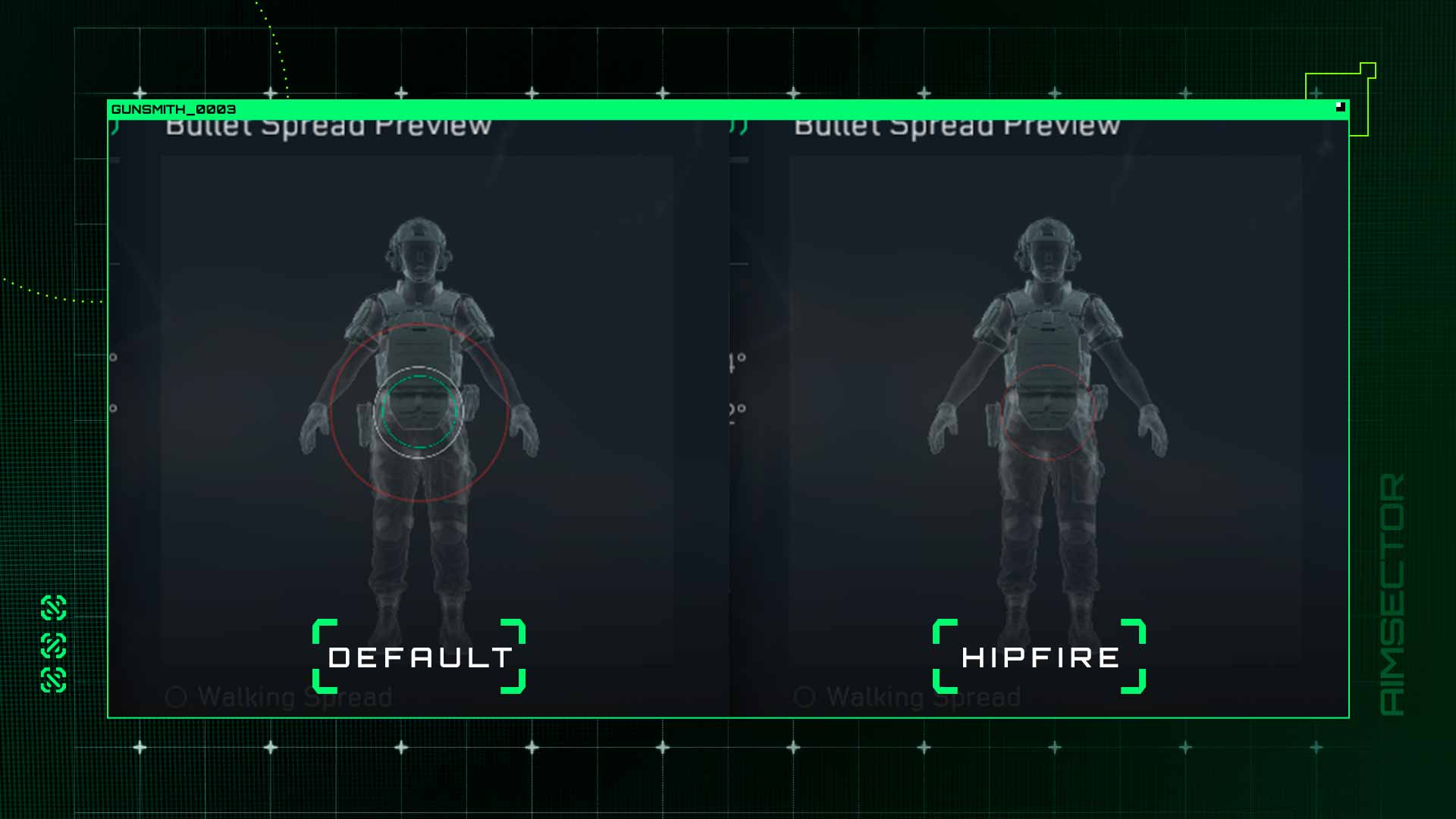
Accuracy is primarily the hipfire stat. It describes how tightly bullets group when you fire without aiming down sights. It does not make your ADS shots land closer to the center of the optic.
When you hipfire, bullets can land anywhere inside a dispersion area. Higher Accuracy means a smaller area. The effect grows with distance, because a small angle error becomes a large physical gap at range.
Like every other stat, the bar hides several values: how wide the spread starts, how wide it can grow, and how quickly it grows during sustained fire. The MP7 patch example earlier shows all three being tuned separately.
When to prioritize Accuracy
- Hipfire SMGs and shotguns. Tighter spread means more bullets or pellets on target.
- Aggressive close-range setups. Hipfire avoids waiting for the ADS transition.
- Rifles used almost entirely with ADS. You can often accept an Accuracy penalty if the attachment gives better Control or Stability.
Accuracy does not fix ADS recoil
If your assault rifle climbs during a long ADS spray, raising Accuracy will not help. That is a Control problem. Accuracy also does not improve ADS speed, scope steadiness or flinch.
There is one nuance. ADS inaccuracy can exist separately from the Accuracy rating. In October 2026, Team Jade fixed an Operations issue where movement-related inaccuracy while aiming with sniper rifles was not being applied. So "Accuracy is only hipfire" is a good rule of thumb, not a law of the game.
Tactical stance
The laser-supported tactical stance sits between ADS and plain hipfire. Do not assume it uses the normal hipfire Accuracy calculation. If you rely on it, test that stance on its own.
Delta Force Fire Rate and Time to Kill
Fire Rate is how many rounds a weapon fires per minute (RPM). A 600 RPM gun fires about 10 rounds per second, and a 1,000 RPM gun about 16.7.
High RPM means faster follow-up shots and potentially a faster close-range kill. It also means ammo drains faster, misses cost more, and recoil gives you less time to recover between shots.
Does higher Fire Rate mean a faster kill?
Not by itself. Time to kill depends on how many hits you need and how quickly they land. For an automatic weapon in simplified conditions:
The first shot lands immediately, which is why the formula subtracts one. For a hypothetical 600 RPM weapon that needs four hits:
This ignores misses, armor, falloff and bullet travel time, so it is an illustration, not a measured TTK for any real weapon. The takeaway: Damage, Range and RPM have to be read together.
Delta Force Muzzle Velocity Explained
Muzzle Velocity is how fast a bullet travels after it leaves the barrel, shown in meters per second. A faster bullet reaches the target sooner, which helps against moving enemies, at long range and with marksman or sniper weapons.
Do not confuse it with Fire Rate. Fire Rate is how often the next bullet leaves the gun. Muzzle Velocity is how fast each bullet travels. A weapon can have a high fire rate with slow bullets, or a slow fire rate with very fast ones.
Delta Force Capacity Stat Explained
Capacity is how many rounds you have before a reload. A bigger magazine helps in multi-enemy fights and lets you miss more without reloading.
But larger magazines tend to cost something. Team Jade's April 2026 notes list Handling and reload penalties for the AUG 45-round extended magazine, and the penalties differ between Operations and Warfare. For a near-1,000 RPM SMG, extra capacity can be worth it. For a slower rifle where you rarely fire more than 15 rounds before taking cover, a big drum may only slow you down.
Delta Force Fire Modes Explained
Weapons can offer single, burst and automatic modes, and not every weapon offers all three. Check the weapon in game.
Fire mode matters for recoil because Gunsmith treats full-auto recoil and single/burst recoil separately. A Control attachment can help one mode more than the other.
Delta Force Armor Penetration Explained
In Operations, damage to health and damage to armor are separate numbers, and neither is the same as your ammunition's Penetration Level.
Team Jade's official Operations guide splits combat damage like this:
| Term | What it means |
|---|---|
| Flesh Damage | Damage dealt to HP |
| Armor Penetration | Damage dealt to armor durability |
| Ammo Penetration Level | An ammunition property that decides how the round interacts with the target's armor level |
| Armor Penetration falloff | A modifier applied to armor damage against higher armor tiers |
Official example: the KC-17
The guide uses a KC-17 with Level 1 ammunition, listed at 34 Flesh Damage and 48 Armor Penetration:
| Target | Result in the official example |
|---|---|
| Unarmored chest | 34 HP damage |
| Level 1 vest, Level 1 ammo | 17 HP damage per hit (50%), and 28.8 armor durability damage (48 × 60%) |
| Level 2 vest, Level 1 ammo | No direct HP damage while the armor holds |
These are the figures from the official teaching example, not independently tested current balance values.
Why this matters: a gun with strong listed Flesh Damage can still perform poorly against armored players if its ammunition is a poor match. A lower-damage gun with better ammo can win that fight.
For ammo tiers and compatible calibers, see our Delta Force Ammo Chart: Every Ammo Type Explained.
Warfare vs Operations Weapon Stats
Team Jade balances Warfare and Operations separately, so the same weapon or attachment can have different stats in each mode.
Official notes regularly list separate base damage, range, Handling, attachment and armor values by mode. The July 2025 MP7 Accuracy change quoted earlier was an Operations change, for example. The AUG magazine penalties also differ between modes.
Two rules follow from this:
- Check which mode a number belongs to before comparing builds.
- A loadout code labeled for Warfare is not automatically the best Operations build, and the reverse is also true.
Operations also adds the armor system above, which has no direct Warfare equivalent. Do not carry Operations armor logic into Warfare builds.
How to Read the Gunsmith Details Screen and Test Your Build
The most reliable way to improve a build is to name a specific weakness, change one thing, and measure the result.
- Identify the problem. Is it recoil, slow ADS, a shaky sight, wide hipfire spread, early damage falloff or a small magazine? Pick one.
- Open Gunsmith, then Details, and find the underlying values for the stat in question.
- Change one attachment at a time and note what improved and what got worse.
- Compare the recoil values, not just the Control bar. Look at vertical and horizontal movement separately.
- Validate in the firing range using the same distance, stance and firing mode every time.
Test protocol
| Test | Procedure | What it tells you |
|---|---|---|
| Recoil pattern | Fire a full magazine into a wall at a fixed distance without correcting | Base vertical and horizontal trajectory |
| Control comparison | Repeat with one attachment change at a time | Effect on recoil and firing stability |
| Visual shake | Record ADS fire through the same optic | Whether an attachment clears the sight picture |
| Stability | Hold the same optic on a fixed point, then repeat while moving | Breathing sway and movement wobble |
| Breath-holding | Compare the same bursts with and without holding breath | Real recoil benefit of the breath-hold multiplier |
| Handling | Record ADS and sprint-to-fire at high frame rate | Real timing differences in milliseconds |
| Hipfire | Fire several groups at the same distance, stance and movement state | Spread, grouping and repeatability |
| Damage falloff | Test unarmored chest damage at increasing distances | Falloff breakpoints and shots-to-kill changes |
If the weapon has any shot-to-shot randomness, one magazine is not enough evidence. Compare several full sprays per configuration under identical conditions.
Which Delta Force Weapon Stats Should You Prioritize?
There is no universal stat order, because weapons have different jobs. Use this table as a starting point, not a rule.
| Weapon type or playstyle | Primary focus | Secondary focus | Often lower priority |
|---|---|---|---|
| Assault rifle, medium range | Control, useful Range | Stability, Handling | Hipfire Accuracy |
| SMG, ADS-focused | Handling, Control | Stability, Range | Extra hipfire Accuracy |
| SMG, hipfire-focused | Handling, Accuracy | Control | Long-range Stability |
| High-RPM LMG | Control | Stability, Range | Hipfire Accuracy |
| Marksman rifle (DMR) | Stability, Control | Range, Muzzle Velocity | Hipfire Accuracy |
| Bolt-action sniper | Stability, Handling | Muzzle Velocity, Range | Automatic-fire recoil |
| Shotgun, hipfire | Accuracy, Handling | Range | Heavy recoil investment |
| Shotgun, ADS | Handling, Range | Relevant recoil values | Hipfire improvements |
This is a practical synthesis of how the mechanics work, not a ranking from the developers. A hipfire Vector and a recoil-focused Vector should not share a stat priority, even though they are the same gun.
Starting point for assault rifles
Begin with Control, then Handling, then Stability, and adjust for the gun. A rifle with naturally mild recoil may gain more from Handling. A high-RPM rifle with strong horizontal movement may need more Control. A heavy long-range build can give up Handling if you rarely fight up close.
Starting point for marksman and sniper rifles
Stability becomes more valuable as magnification rises, because you spend more time holding angles and fighting sway. Muzzle Velocity and Range matter more because targets are usually farther away.
Building a near-zero-recoil gun
You cannot reach literally zero recoil with attachments alone, but you can build a gun that needs very little manual correction. In order of priority:
- Lower the full-auto horizontal recoil multiplier, because sideways drift is the hardest to correct. If your gun already has little horizontal recoil, start with vertical instead.
- Lower the full-auto vertical recoil multiplier.
- Improve weapon stability while firing.
- Improve lens firing stability if the sight still shakes.
- Use breath-hold where the situation allows.
Compare muzzle, foregrip, stock, rear grip and barrel options by their recoil modifiers, not their total Control bonus. Expect to give up some Handling.
Common Mistakes When Reading Weapon Stats
- Maximizing the biggest green number. An attachment's summary bonus can hide a worse change to a more specific value.
- Treating Control and Stability as the same stat. A steady sight picture does not mean the recoil path is controlled.
- Assuming Accuracy improves ADS. It is mainly a hipfire stat. ADS recoil belongs to Control.
- Judging Damage without Fire Rate or breakpoints. A higher-damage gun does not automatically kill faster.
- Maximizing Control at any cost. A gun that barely moves but takes forever to aim is not a good build.
- Ignoring Range. Two guns with similar close-range damage diverge once falloff begins.
- Confusing Armor Penetration with Penetration Level. One is damage to armor durability. The other is an ammunition property.
- Assuming Warfare and Operations stats match. Check the mode first.
- Equipping the largest magazine by default. Extra capacity can cost Handling and reload speed.
Delta Force Weapon Stats FAQ
What does Control do in Delta Force?
Control manages actual weapon recoil: vertical and horizontal movement in automatic and single/burst fire, plus weapon stability while firing. If your gun climbs or drifts when you shoot, Control is the main stat to improve.
What does Stability do in Delta Force?
Stability affects how steady your sight picture stays. It covers breathing sway, breath-hold, hit flinch, movement wobble and lens shake while firing. It is not a substitute for Control.
What is the difference between Control and Stability?
Control affects where the gun moves because of recoil. Stability affects how steady the gun and sight feel while you aim and fire. A good recoil build often needs both, but they solve different problems.
What does Handling do in Delta Force?
Handling is weapon responsiveness. It includes ADS time, sprint-to-fire delay, movement speeds, reload times and weapon switching.
What does Accuracy do in Delta Force?
Accuracy is mainly hipfire spread. A higher value tightens your hipfire grouping. It does not reduce ADS recoil, so improve Control for that.
What does Range mean in Delta Force?
Range is the distance over which a weapon keeps its first damage tier. After that, damage falls according to the weapon's own falloff profile. It is not the maximum distance a bullet can travel.
What does Muzzle Velocity do?
Muzzle Velocity is how fast the bullet travels after leaving the barrel. Higher velocity cuts travel time, which helps against moving targets at distance. It is separate from Fire Rate.
Does higher Damage mean faster kills?
Not necessarily. Time to kill also depends on Fire Rate, hit location, distance, armor, ammunition and how many shots you land. Small Damage changes matter most when they cross a shots-to-kill breakpoint.
What is the most important weapon stat in Delta Force?
There is no single answer. Control is often the best starting point for automatic rifles, Handling matters most in aggressive close-range play, Accuracy matters for hipfire builds, and Stability matters most with magnified optics.
Is Control or Stability better for recoil?
For reducing actual recoil, prioritize Control. Stability helps with sway, flinch and sight shake, and holding your breath adds a further recoil reduction.
Is Armor Penetration the same as Penetration Level?
No. In Operations, Armor Penetration is the weapon's damage against armor durability. Penetration Level is an ammunition property that affects how the round interacts with the target's armor.
Are Warfare and Operations weapon stats the same?
Not always. Team Jade balances weapons and attachments separately for each mode, so confirm which mode a stat or build belongs to before comparing.
More Delta Force Weapon Guides
Once you understand the stats, see how they play out in real builds:
- Assault rifles: Best M4A1 Build and Loadout Code, Best AUG Build and Loadout Code and Best K416 Build and Loadout Code
- SMGs: Best MP7 Build and Loadout Code
- Ammo and armor: Delta Force Ammo Chart: Every Ammo Type Explained
- Everything else: the Delta Force Weapons hub and Best Delta Force Loadouts and Build Codes for Every Gun
How to Build a Better Delta Force Weapon
Start from the problem, not the bars. If recoil is the issue, look at Control and its vertical and horizontal values. If the gun feels slow, look at Handling. If the sight feels shaky, look at Stability. If hipfire is wide, look at Accuracy. If damage falls off too early, look at Range. If moving targets are hard to hit, look at Muzzle Velocity. In Operations, never judge a gun without also considering armor and ammunition.
Then change one thing, open the Details screen, and see what really moved.
A good Delta Force build is not the one with the highest total stats. It is the one whose trade-offs match the fights you intend to take.
About the author
Marcelo covers FPS games at Aim Sector, drawing on a decade in esports as a player, coach, manager and media executive.
View author profile →